Showing posts with label TV/Film Review. Show all posts

Thursday, December 29, 2016

Hello, My Twenties! // Age of Youth (2016)

Once you've binged on all of the standard "good" Netflix television, there's nothing left to watch unless you start choosing shows at random. Embarrassingly, I reached that point. If I hadn't, I wouldn't have stumbled upon this treasure: the South Korean dramady known on Netflix as Hello, My Twenties!


Screenshot from trailer
Netflix seems to have recently acquired a lot of East Asian programming, and they are not marketed as well as other foreign TV/Film is, in my (serious) opinion, which is deeply unfortunate. My own biases come into play as well, and honestly, most of the shows don't look appealing at first glance. The larger-than-life stereotype of South Korean media precedes it, and I have inadvertently written it off. I know that I am not the only one to do so, and it is unnerving how complicit Netflix and other outlets are in this as well.

In many ways, the show reminds me of Crazy Ex-Girlfriend in that its comedy is big and centers on single women. Yet, somehow these thematic similarities are not as strong as the similarities that the show has simply for its country of origin, according to Netflix. For example, all 25 of the "more like this" shows listed are East Asian shows. I argue that not having a single show "like this" from any other part of the world shows that Netflix pockets these show together, no matter their content. Two of the four genres Netflix tags for Hello, My Twenties! have Korean in the title (Korean TV Shows, Korean Dramas) and the other two are vague and overlook the comedy of the show (TV Shows, Romantic TV Shows). I would love to see this show represented more accurately, so that more people will be likely to enjoy it for what it is as opposed to writing it off due to stereotypes. In the process, stereotypes across the board will be broken down. 

Anyway, I had exhausted the Netflix programming I was interested in and despite this, my boyfriend is a media-holic who constantly needs noise in the background while he works, and I either needed to choose something or have to deal with an intense true crime show. I opted for the random click, with the mindset of oh boy, what are we getting ourselves into. Soon, I was  coming home from work and immediately turning on the show, staying up past my bedtime to watch another episode in its entirety. 

It starts off stereo-typically South Korean, larger than life in an overwhelming way. The show opens on Eun-jae (Park Hye-soo*), who happens to be my least favorite character, as she moves into a new apartment in Seoul with four female housemates. Eun-jae is a doe-eyed little babe, just starting her first year at college. She is nervous and awkward, and I can't help but find her totally annoying. 

The series takes turns exploring the lives of each of the housemates, who each have very distinctive personalities.

Screenshot from trailer
In addition to Eun-jae, we have Kang Yi-Na (Ryu Hwang-young), who is tall and attractive, with a bold confidence and over-it attitude that exudes from her sassy quips. Song Ji-won (Park Eun-bin), the quirky weirdo who has never had a boyfriend and is alternately distressed by this and boldly whatever about it--my absolute favorite of the five. Jung Ye-eun (Han Seung-yeon), who is a little over-the-top, always dressing in pink, very concerned with her appearance and her social life, particularly her boyfriend. Finally, Yoon Jin-myung (Han Ye-ri), who works multiple jobs and is struggling to keep her head afloat, stubborn in her self-sufficiency. 

As in reality, these women would not have become friends if they weren't living together. Somehow, becoming roommates with other women,  brings me closer to them in a way that would not have been possible or even necessarily desired had I not lived with them. The series shows the ups and the downs of their intermingled and individual lives--revealing beautiful moments of unexpected friendship and loyalty, and painful moments of tension. I can't express how well this show depicts female friendships. Some of the loving, loyal scenes between the women nearly bring me to tears with joy. 

In addition to all of the relatively normal story threads, the women all have hidden pasts that they are dealing with, and a ghost seems to be haunting the house. I hate to give any of the plot surprises away, but trust me when I say that the drama gets real. And it gets good. 

Screenshot from trailer
The writing on the show is fantastic. Humor comes in unexpected ways, and I laughed out loud like I did with Chewing Gum and Crazy Ex-Girlfriend, reveling in the absurdity and cleverness of different lines and plot lines. The editing is superb--quickly changing tones drastically but smoothly, purposefully done to keep us on the hook. Mid-late season in particular had me hating the writers and editors because I knew I was being manipulated, but I loved it. 

There are many more hidden treasure moments in the series--from the single woman who they rent from, always shown enjoying herself in her garden, to the men in and out of the girls' lives, to the after-episode interviews with the characters. It's fantastic. 

As always, my criticism:
  • There are stock video clips interspersed throughout, making the tone very weird. Especially when considering that the stock videos never seem to represent Korean people--mostly white ones. 
  • The same two-three songs are constantly used, and I wish that there would be more diversity in song choice. (Apparently this is common in K-Drama?)

Overall, I highly recommend Hello, My Twenties! to anyone who enjoys well-done "big" comedy and female-driven media. It is such a fantastic, relatable series. Both my boyfriend and I are completely invested. 


*Written in the structure of family name followed by first name, as generally written in Korean


Friday, December 23, 2016

Lovesick aka Scrotal Recall (2014-)

Netflix really wanted me to watch Scrotal Recall. Despite its insistence, I never did because hello, it's called Scrotal Recall. Ew.

Dylan (Johnny Flynn), an adorable British blondie, tests positive for chlamydia, prompting him to reach out to all the women he has ever slept with to let them know. The series chronicles his present-day interactions with these women as well as the key moments from these relationships/hook ups past.

Screenshot from trailer
The first question you're probably asking is: why would his guy contact all of the women he has ever slept with the moment he finds out he has an STD? Wouldn't it make more sense to go backwards, rather than going straight for that random person he hooked up with six years ago or whatever? Yeah, I don't know. I'm totally glad he's taking responsibility and letting everyone know, but this logic just doesn't make sense. It's the entire foundation of the show though, so...

Scrotal Recall originally aired on the UK's E4 channel, but season two was all backed by Netflix who, realizing the reason for its unpopularity, took it upon itself to rename the show Lovesick.

The first season was surprisingly fun. The episodes travel through time, chronicling not only the romantic relationships entangled in Dylan's life, but also the friendships. The audience watches the growth of characters in one episode as they would over the course of many seasons of a traditional show. It is done well, and it works, capturing the fluidity of time and experience.
Screenshot from trailer

Evie (Antonia Thomas) is consistently well-acted and magnetic. She is friends and housemates with Dylan, though she watches his changing relationships with a look of sadness and longing in her eye, wishing she were in his lover's place. Though the series centers on Dylan, Evie's character is the more engaging, dynamic one. The audience is endeared to her, rooting for her.

The series also features Luke (Daniel Inges) as the pair's sleazy friend whose loud confidence and escapades with women propel both Dylan and Evie's plot lines in silly, unexpected ways.

That first season captured me, but the second, headed by Netflix, tried to change the show's direction while keeping the same format. Season Two relies more on remembering the chronology of these time traveling vignettes while developing a more traditional, straight-shoot plot thread. The people involved in the show are talented, and if given the a better script I bet the show would continue to be great, but as is it is a little confusing.

Screenshot from trailer
The show worked when Evie and Luke were the only characters surrounding Dylan whose roles and histories were consistent, but by adding Abigail (Hannah Britland) to the mix it gets to be a little much. Perhaps if she were someone new he has met rather than someone with a history that is lost in the swirl of other histories it would work better. As-is, I forget many significant details and don't see a true connection between the two. If she had been new, the series could have explored telling someone you just met that you have an STD and working through that.


Watch the trailer here


Sunday, December 18, 2016

Grosse Pointe Blank (1997)

Ten years out of high school, do you still harp on moments lost and opportunities missed?  If you answered yes to that question, then perhaps you'll enjoy Grosse Pointe Blank (1997) more than I did. I sure hope not, though, because that's awfully sad.

Screenshot from trailer || My face at this movie
The premise of the film is that Martin (John Cusack), an assassin for-hire, has to go back to his home town to kill a man and attend his high school reunion. There he re-encounters his ex-girlfriend, Debi (Minnie Driver), the lost love of his life who he wishes to reconnect with after leaving her on prom night ten years ago and never seeing her again.

This movie sucks, and here are some reasons why:
  • It is boring as hell and nearly two hours long. 
  • There is next to no character or plot development and I am left with countless questions. Why exactly did Martin leave Debi? Why doesn't he have an oft-used cover-up profession for when people ask? Has he not dated since high school? Has she not dated since high school? Did he even graduate high school? How come we didn't have any prior hints that the other hit men were after Debi's father? Why were they after him exactly? Why is Debi still in this small town, despite having the money to easily leave? Also, Debi's character seems to change with every scene. 
Screenshot from trailer
  • The camera work is consistently awful. The framing is unprofessional, and canted angles are used annoyingly. 
  • Martin's secretary (Joan Cusack) has a role that is out of sync with the rest of the film. She seems irrelevant, but she cares a lot. Why does she care so much about Martin going back home? Wait, why does Martin keep messing up so much at his job, leading him to Detroit, right near his hometown, in the first place? Obviously, the questions never stop.  
  • The therapist is an unnecessary addition.  I see where the humor is supposed to come from, but it falls flat and is carried on for too long with no payoff. 
Screenshot from trailer
  • I am so confused about who is trying to kill who and why.
  • The reunion seems secondary, yet is talked about greatly throughout the film. A man dies there, and nobody seems to really care, and nobody reports this to the police. 
Overall, the film left me with near constant confusion. It was poorly written, poorly acted, and poorly filmed. It sucked. But if you're still interested, you can watch the trailer here. 

Males Gazing, 1970's French Erotica, and Fantasy vs. Reality

While at the gym yesterday, lying on a workout bench, lifting ten pound weights over my head, I caught the eye of some guy, maybe late high school, maybe early college age (it's hard to tell with dudes) standing nearby, watching me. He didn't seem to be working out, so at first I thought I had taken the bench he was using on accident. No, I realized--just before I had come there he had been doing shoulder presses at a machine in front of where I had been doing the same, across the room. I closed my eyes, and continued with my reps. As I changed positions for another exercise, I opened my eyes, making eye contact with him again. I quickly finished my workout and left the bench.

Eye contact is an unspoken hello, welcoming further contact. It is supposed to be equal for both parties, but when someone is actively trying to make eye contact with you, not taking hints that you aren't interested, it feels like their eyes back you into a corner. That's how it feels to me, anyway.

I felt the same need to avoid eye contact while out dancing with friends last weekend, towards the end of the night when a group of single men joined our group of single women in a dance circle. This would have been fine if the men weren't trying to catch my gaze, and I hadn't felt pressure to look them in the eye, which I very well knew would be a loud club's "okay" to dancing with them, which I didn't want to do for a variety of reasons.

Eye contact isn't actively threatening. It's just eye contact. But because of this nonverbal "okay", when I sense that someone is trying to get my eye contact without cease, my guard goes up.

Yet in my own fantasies, where I create a realm of safety for myself, this eye contact isn't threatening.

If someone asks me what I did this weekend, I'll say any number of things, but I probably won't talk about the 1970's French erotica films I watched, most produced by the Alpha France production company.

I haven't done a ton of research on these films. A documentary is on my list, and I found the sex positive blog and radio show of one of the former actresses. I look forward to learning more about this time and place in erotic films, but for now all I can say is that I like them. They are far from feminist, mind you, but I like them.

The films take an everyday scenario and seamlessly ease them into eroticism. Eye contact is the nonverbal yes, but there is a sense of safety and fantasy in the scenes that allow the yes to be enthusiastic.

The fantasy argument is used often in erotic films, but this specific group is unique. They are not taking a situation that would be off-limits, filming it, and claiming that because the situation is controlled, it is fantasy. The implied reality of those types of scenes make my guard go up, much like simple, unwanted eye contact does.

Instead, the content of these films lends itself to fantasy. The camerawork, design, and story lines are obviously inspired by French New Wave, a fantastical genre. The films live in a dream-like world where a woman knitting on a couch wordlessly turns suggestive, where eye contact made at the dinner table turns into much more. It is a world sans the potential for negative physical or emotional repercussions to sexual experiences. The world is one where all players share a comfortable ownership of their desires and sexuality. This is not the real world. This world portrays the dreamlike scenario of safe, spontaneous eroticism. By creating a blur of fantasy and reality, the films successfully create a visual representation of erotic fantasies inspired by daily life.

It's weird how mixed up different interpretations of eye contact can be. In Luis Buñuel and Salvador Dali's Un chien andalou (1928), there is a scene where a man gropes a woman. The two make eye contact before the man grabs her breasts. He has a hungry, predatory look in his eye. The woman varies in trying to free herself and allowing him to grope her, though her expression makes it clear that this is violating her will. In "reality", she is clothed, but in the "fantasy" of the the scene, cut between frames of he reality, her breasts are bare. (

We discussed this scene in a college film class. One (sincerely well-meaning) guy made the comment that he believed that this scene represented a consensual act, because the woman did not fight back. He didn't mention eye contact but, to me, the eye contact and lack thereof was far more telling than her "fighting back".

Me being the sometimes overly outspoken person I am, responded rather intensely that this scene represented something far from consensual. I referenced BDSM somewhere in my retort, comparing consensual sexual acts like that to a scene like the one represented in the film. My class probably learned a little too much about me then, and the poor guy who had made the original comment looked sincerely distraught and thoughtful.

Not fighting back is not consent. Neither, necessarily, is eye contact.

There is a great deal more going on in these scenes than eye contact. I do not wish to simplify something that is complex and often threatening, but eye contact, as simple as it is, can be powerful. Especially as it relates to sexual fantasies and realities. Eye contact alone is not an invitation for further interaction, the type of eye contact matters. Body language matters. Nonverbal cues matter.


Wednesday, December 14, 2016

Crazy Ex-Girlfriend (2016--)

Screenshot from trailer
As the friend who recommended Crazy Ex Girlfriend to me noted, a quasi -musical comedy on the CW where a woman follows her ex from summer camp ten years ago across the country to set down roots does not sound like great television. Yet, it is great fun television.

The show seems like an amalgam of other popular female-driven comedies on TV--New Girl, Parks and Rec, 30 Rock...It nods their way, but also adds its own freshness. Rachel Bloom, star and creator of the series, has a thing for parodied music videos, and the show is peppered with these. My favorite being:


Some of them are on point, while others are kind of a drag. It varies. 

The show is weird and all over the place, but somehow, the majority of the 18 hour-long episodes in the first season kept me entertained. The cast is diverse, the plot lines are easy to follow, and some of the jokes are great.

One of my favorite characters is Paula (Donna Champlin), best friend of Rebecca (Rachel Bloom). Paula is fuel to Rebecca's craziness, the ultimate enabler. The middle-aged mother of two is dealing with dissatisfaction in her own life, and uses Rebecca's obsessions as a distraction. Though the show centers around Rebecca, I find Paula the more interesting, complicated character. Through Paula, we get a peek into the life of a character who has passed the dating stage, who has not reached the career heights she aspires to, and whose domestic life is completely detached from her self. We see her seeking a life she in which she finds happiness.

White Josh (David Hull) is fantastic. He goes from a total periphery character to the love interest of Rebecca's formerly straight-identifying boss, Darryl (Pete Gardner). Never is White Josh's sexuality a focus, until Darryl begins to recognize sexual tension. For Darryl, this new aspect of his sexuality is overwhelming. White Josh, on the other hand, is comfortable and confident with his sexuality. These two men are very different people in very different stages in their lives. I love it.

Also, can we talk about how White Josh has the race-associated nickname instead of the other option, being Rebecca's love-interest Josh, being named Filipino Josh? I love that it is the white character whose whiteness is brought to attention, as opposed to a character of color, flipping the tradition of singling out people of color for their race.

The show could be tighter, some of the music videos could be cut, and the occasional precocious children could certainly be done without, but overall the show is fun and well done, and is deserving of the support and acclaim it has been given. 
Screenshot from trailer


Tuesday, December 13, 2016

Keanu (2016)

This is not usually my cup of tea. For me, "action-comedy" translates to "eye roll", and I didn't grow up watching Key & Peele, so their names didn't change my perspective. Despite my hesitation, my partner convinced me to give it a shot with an argument along the lines of "it's about a baby cat! Who doesn't love a movie about a kitten!?".

Screenshot from trailer
Don't let the film poster deceive you, this is not about a kitten who can talk or any other form of personified nonsense (except in one dream sequence, which I'll get to later). This kitten is a totally normal, adorable kitten who just happens to be caught up in a lot of bad situations.

We open on a scene somewhere in Mexico, at the headquarters of a drug cartel doing its work. Enter two scary looking dudes, known as the Allentown Boys, who shoot the lot of them and take all of their money. The only living thing spared is a tiny kitten.

The tiny kitten ends up wandering its way into Rell's (Jordan Peele) life, right when he needs it most: his girlfriend just dumped him, and he has been a mess ever since. Rell loves Keanu, as the kitten has been named, dearly, so when he comes home from hanging with his buddy Clarence (Keegan-Michael Key) to find his apartment trashed and his kitten gone, he is devastated, but quickly turns that devastation to determination to rescue Keanu.

The movie takes many turns; it had the pacing of an action movie, a strong central story line, well-placed recurring gags, and a sense of urgency on the part of both Rell and Clarence that was ridiculous but believable. It had laughs for everybody and, like my boy said, who doesn't love a movie about a kitten? The film kept my attention and continued to build upon itself until its conclusion, never letting a boring minute go by.

There were a few stand-out scenes and performances, including Anna Faris playing herself as a drugged-out thrill-seeking borderline-scary drug customer. We don't know that she is playing herself until fairly well into the scene, when Rell says that he "loved her in The HouseBunny", which makes the whole thing click. That space between recognizing her as a famous actor and realizing that she is playing herself is a beautiful crack between the story line and reality that is unexpected and delightful.

I loved Hi-C (Tiffany Haddish) on a general note. The scene in the bar where Rell and Clarence argue about how (un)intimidating their speech is while in a tough gang's bar is another highlight.

My favorite tidbit was a very minor part of the film: Clarence's wife, Hannah (Nia Long). While Clarence is busy hanging out with a violent gang in an effort to retrieve Keanu, Hannah is stuck on a trip with her daughter, her daughter's friend, and that friend's father, Spencer. The plan had been for his wife and Clarence to both be in attendance, but circumstances (sickness and kitten rescue, respectively) prohibited this. All of this was revealed after Hannah was in the car, seat belt on and ready to go, sitting in the passenger seat with Spencer (Rob Huebel).
Screenshot from trailer

Immediately, the audience feels that something is going to happen. It is unclear what, exactly. Is Spencer going to try something on her? Is Hannah going to cheat on Clarence? Hannah's mix of discomfort and casualness feels familiar to me. The feeling of being alone, in close proximity with someone who you feel weird about in some subtle way, pushing that feeling aside becausembrace the fact that vibes aren't everything. Nia Long shows me these feelings in a short scene with little dialogue, and I can see it.

Later on, during the height of the film's action, we meet Hannah again as she calls Clarence to tell him that she is returning home early because Spencer had acted "inappropriately". Neither Clarence nor the audience learns any more than this then, or later. All we know is that he had been inappropriate, she felt uncomfortable, she is coming home early.

Screenshot from trailer
I love this. We don't get the opportunity to judge the situation. We don't get the opportunity to judge Hannah's discomfort. What matters is that Hannah was uncomfortable because of Spencer's actions, whatever they were, whatever degree of inappropriate, whatever line personal to Hannah that he had crossed. By not revealing the details, we are inclined to, and given little choice but to, trust Hannah. Clarence is overtly pained and concerned, and we too trust her judgment; we are concerned for her safety and well being. We respect her, in a way that would not have been as obvious or powerful had she explained what Spencer had done.

Back to the larger film; my biggest complaint is the dream sequence, in which kitten Keanu is voiced by Keanu Reeves. Despite the comedic elements, it was entirely unnecessary and strayed from the bigger picture. I have mixed feelings about the conclusion, but it's hard for me to imagine a proper way to end the film, so I will let it slide. Ultimately, this film was structured so that I could appreciate scenes individually as well as the film as a whole. It is a fun, much-needed laugh.

Watch the trailer here


Tuesday, November 1, 2016

To Wong Foo, Thank For Everything! Julie Newmar (1995)

A full tank of gas, great friends, and a larger-than-life destination: the recipe for the perfect road trip.
Screenshot from trailer

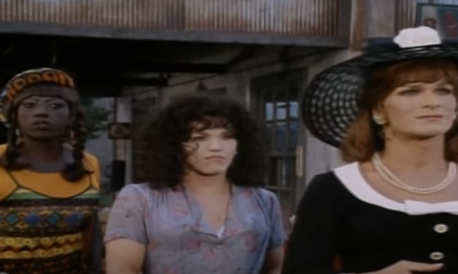
Bumps in the open road are to be expected to some extent, but the three drag queens in To Wong Foo, Thanks for Everything! Julie Newmar have a few more bumps than their fair share. Nothing goes as planned, and the cross-country adventure takes a few unexpected turns, leading to some unexpected destinations.


Screenshot from trailer
Despite the bumps, our characters prevail, as does the film, which stars three dreamy actors as Noxima, Vida, and Chi-Chi (Wesley Snipes, Patrick Swayze, and John Leguizamo).  Each of these actors are known for playing highly masculine roles (EXAMPLES). This is a fantastic move on the part of casting. This polarity between the feminized roles and the masculinized fame creates opportunity for a powerful commentary on gender expression. Men known for their masculinity are playing characters dressed in drag for a film that embraces gender diversity and fluidity.  What better way to put the concept of gender norms into question? Their masculine fame opens up opportunity for those who would not normally venture to see this film to do so, reaching an unlikely audience, and allowing the male viewers to put themselves in these women's shoes. We are endeared to these three characters not just because of their character, but because of the real person we see portraying them.

Screenshot from trailer
The film sheds light on gender violence of varies kinds--from a cop harassing the three women to a husband who beats his wife.  Not only do we witness our three protagonists receive push back on their line-crossing of gender norms as men dressed as women, but we witness how they are endangered simply by being women. The film confronts the issue unabashedly, and it is better for it.

To Wong Foo shows a small, rural town in the Midwest opening up its community to three gender-bending drag queens. They are the winners, united with the unlikely allies of the townspeople, while the cruel cop who has made it his goal to wreck havoc on their lives is shown to be an absolute idiot. By the end of the film, the whole town has come together in celebration, with every individual claiming that they are a drag queen--that they will stand by their friends, that they are on their team. The push back against homosexuality is shown to be utterly absurd.

Screenshot from trailer

One thing I do not understand is why they included the basketball and hotel scenes. I'm sure it was somebody's "baby", but it had nothing to do with the rest of the film and should have been cut.

Watch the trailer here


Chewing Gum (2015--)

Ahh, pre-sex lust. That odd fascination with an  act desperately wanted, never experienced, and always hushed up. Remember your pre-sex teenage lust? Think about it for a moment, just enough to feel embarrassed.

Screenshot from trailer
Perhaps, like myself and Chewing Gum's Tracey, your religious beliefs had you holding that lust at arm's length for awhile. A lusty fermentation.

Airing originally on the U.K.'s E4 channel, Chewing Gum takes place in London, and features Tracey (Michaela Coel), a 24-year old British woman still living at home with her deeply religious mother and sister, still dating the man she has been with for the past six years without so much as kissing him. She tries to stay devout, but sex won't stay off her mind. When it all comes down to it, she would rather be licking a man's face than praying to Our Lord Savior or spending the night playing another game of Ludo with her sister. Once Tracey unleashes her desire onto the world, life gets a little crazy.
Screenshot from trailer

Sex is sloppy and confusing at first, and nothing screams sloppy and confusing like Tracey's attempt at being sexy. The series explores her coming out of the darkness of her religion and into the blinding electric lights of life.

This is not reality as we know it. This reality is bolder, more dramatic, heightened and extended beyond the norm in the best possible way. This is a world where grandmothers take off their tops at parties and where hit-and-run victims refuse help from a sinner. The comedy is a modern slap-stick. Even when the laughs are not physical (which they often are), the outlandish situations nod to the physical.
Screenshot from trailer

Chewing Gum
 is hilarious. It is quick-paced and jam-packed, but I do not get lost. The series has a strong enough spine to keep the story straight and engaging, though it is flexible enough to take the viewer on countless twists and turns. The jokes are witty and unexpected, making me burst out laughing with empathy and recognition. Every actor plays their role with brilliant dedication. In short, don't take my word for it, go watch this series because it deserves a crowd.


Just realized that  Michaela Coel  also writes the show, which is based off of one of her plays. She is officially brilliant.

Watch the trailer here

Monday, October 31, 2016

Insecure (2016--)

I am so excited that Insecure exists. I am so excited that it exists on HBO, a major network. It is no secret that black-driven media is severely lacking in the mainstream. This show is pretty damn important in the sense that it is driven by black voices in front of the camera as well as behind the scenes, and that black women are central to its plot and creation.

Issa Rae, the brainchild behind the Awkward Black Girl YouTube series that Insecure builds and extends upon (HBO, I see you and your video-site poaching!), is funny. But that's an understaement. this woman knows how to make the uncomfortable of everyday into an art. Her humor pokes fun at everyday life, confronts the absurdity and upsetting double-standard of micro-aggressions* and racism, and is totally, lovably self-deprecating.

Screenshot from trailer
Her best friend, Molly (Yvonne Orji) is a brilliant addition. While Issa is an open hot mess, Molly seems like she has her shit together, and tries very hard to make it appear that way. She has the job, the style, and the personality--but she is not so much unlike Issa. Neither of them have their shit together. None of us really do.

Insecure has solid material, a talented cast, and the support of a major network. But it needs work.

Great jokes get lost in scenes cut too long. The pacing is paradoxically too fast, yet too slow. Plotlines are not explored deeply enough to seem significant or make sense in the show, yet they are explored too long for the viewer to not expect more (example: Issa & Molly's "Broken Pussy" rap fight, the kids going to the beach, Molly's coworker's experience with being "too black" for the office--all great plotlines that either need to be explored with more attention or not at all).

Ideas are free-floating within an episode, without the much-needed episodal or season spine holding them together. Sure, the former may be more like real life, but we are not watching to see real life. Real life is boring. We are watching to see real life represented through storytelling, and that takes some organization. As is, the series often bores me.

I hope to see the series find its form as time goes on. The potential is abundant.


Screenshot from trailer

*I spoke in another post of my frustration with college activist jargon, so it is unfair to use the term micro-aggression without an explanation. This term refers to actions and comments that subtly (though sometimes not so subtly) show and promote racism. Micro-aggressions can take many many forms, from references to stereotypes in speech, to a customer service representative watching some customers more closely than other, etc.


Watch the trailer here

Saturday, October 29, 2016

High Maintenence (2016--)

Screenshot from trailer
Many people try to stretch a good thing until it rips. Fortunately, even after transitioning from a Vimeo short series to a 30-minute long HBO series, the creators of High Maintenance have kept the show's essence strong.

Each episode is nostalgic. The kind of nostalgia characteristic of experiences you have never had, the kind of nostalgia that doesn't anchor itself to any specific moment, but to all moments in a squinty-eyed Christmas-tree-light-fuzz kind of way.

High Maintenance is a series of vignettes connecting New York's inhabitants--beings of differing ages, lifestyles, backgrounds, identities, species--by a pleasantly average weed dealer. Each vignette is crafted with care, holding each character and their story to a high level of respect. The series thrives by its placementy of each character on this oddly level playing field of being human (for the most part). Despite drastic differences in their everyday and their challenges, they are united. Yes, they are united by the dude selling them all weed, but they are also united by something...bigger. Don't get me wrong, differences are not glossed over; they are present, but characters and viewers are united with the commonality of being human.
Screenshot from trailer


I'll mark this as to-be-continued because I have much more to say on the show, and I have been meaning to write about it for awhile. For now I need to head to the gym (trying to strengthen my arm & back muscles so that I stop hunching!).

-

I am back a few days later before 5 in the morning on a workday because I can't seem to sleep. Anyway.


To sum up what I had written earlier, each episode feels like a package wrapped carefully and intentionally. From the asshole hipster pair to the older Chinese immigrant couple to the neglected dog, the series spans wider than others do. Individuality is highlighted where at first it may not appear to be present, and vice versa, actually. I am thinking of the episode featuring the Muslim teenage girl, whose mere appearance calls her belonging into question. We see her struggling with the common experiences most American teenagers face, no matter their background--her balance of family and self, her exploring of who she "is", along with more individualized challenges.

Screenshot from trailer
It struck me, watching this, that I truly do not remember another fictional piece of media I have consumed that features a Muslim family. This was not something I was unaware of before, but seeing such a powerful depiction of this character forced me to acknowledge my lack of exposure not just intellectually, but emotionally. I felt, and feel, a renewed anger about the lack of representation of a variety of people and experiences in mainstream media.

Of course, when I feel this way I have to check myself. Young, upper-middle class, Christian-raised, white woman isn't the most lacking demographic in American media. My own identity, though mainstream media still has quite a way to go in its representation of women in general, white women included, is pretty goddamn represented and comfortable, comparatively. I am learning the art of balancing my identity with my emotional response to inequality because my identity allows me to experience these emotions only empathically. I have the ability to detach from the emotions if they become inconvenient because they are not of me. I am trying to understand how to care without being capricious.

Screenshot from trailer
That was a major tangent, but I will keep it here. That train of thought is an important part of High Maintenance. These vignettes call upon the viewer's engagement. They are too short to think for us; they leave too many ends open, so we have close them ourselves.

Watch the trailer here

Wednesday, August 24, 2016

Barbarella (1968)

Barbarella-french-film-poster.jpg
Wikipedia
If you haven't seen this film, it is my highest recommendation that you change that.

Barbarella is such a fun romp of a movie. A SciFi playground of sex and adventure, featuring Jane Fonda looking hella good in every one of the many outfits that Barbarella wears. I've been meaning to be her for Halloween, because if it were up to me I'd be dressing like her every day, but the rest of the world wouldn't approve.

The aesthetics of this movie are wonderful. The set, the costumes, the camera--it is all really bright and engaging. Barbarella's/Jane Fonda's sex appeal is certainly a huge part of the movie, but it isn't the kind of thing that upsets me. Sure, she is a traditionally beautiful woman being objectified and ogled, but it is very tongue-in-cheek. I mean, come on, she doesn't know how Earthly sex works, and when she learns (because she is so willing to learn!) she finds that it is damn fun. She doesn't have all of the negativity associated with female sexuality drilled into her brain, so she is happily open with her love of sex and eager to explore. I mean, come on, she is supposed to die in that orgasm-inducing machine, but her larger-than-life orgasm breaks it, and she escapes! This is definitely the premise of a bad porno, I know, but I think it is more silly and positive than icky and uncomfortable. Aside from sex, she's also on a mission to take down a bad guy.

Screen shot from trailer
The world needs more movies that are as fun as this one.


Wednesday, August 17, 2016

Tangerine (2015)

Screenshot from trailer 
This is one of my absolute favorite movies. I say this upfront to prepare for a mostly excited, positive review.

What's so great about this movie? That's a question that, from my experience, would come from someone who hasn't seen it. Though today, IMDb has it rated just barely above a 7 our of 10.

First of all, this plot is unique. A woman gets out of jail, finds out that her boyfriend has been cheating on her, and goes on a flying rage down the L.A. streets to find him. To get into her demographic deets, the woman is a black, transgender prostitute. To get into his, he is a white pimp. Surely this is not the norm we have grown to know in films! This plot is woven into a plot about a taxi driver who, though married to a woman, has an extra curricular interest in some of the nontraditional prostitutes.

The camera---oooh am I a sucker for good camerawork. You give me good camerawork filmed on an iPhone? Well, shoot, should we just go to bed together now? Seriously. The whole iPhone thing is a big hit to viewers and critics alike. The camera on recent iPhones is pretty great, especially for a phone, sure, but this type of cinematography takes skill to capture on a camera made for this work. We won't even go into how the toggles and tools on an iPhone are certainly not made for easy filmmaking.
Screenshot from trailer

The acting/script combo? So good. This is a comedy, mind you, but not the kind of comedy that makes fun of the out-of-norm characters. It watches like an in-joke, not an out-joke. Sin-Dee (Kitana Kiki Rodriguez) is especially hilarious, but if I were going to go through everyone's acting, I would end up just listing names and saying "ugh so GOOD". I'm also pretty certain that Kitana isn't a professional actor, either.

This is actually a terrible review because all I want to do is say "ugh, so good" to every bullet point I have on it. It's like the opposite of  my MEDG review.

I really enjoy this movie for its sharp acting, writing, and cinematography. I enjoy the roller coaster of events. The realness that is not diminished by its exaggerated comedy. The first time I watched it, I was with friends. I had plans to hang with my boyfriend when it was finished, and immediately went to his house and told him that we have to watch this movie, now. So I watched the same movie twice in one night, back-to-back.
Screenshot from trailer

A man temporarily teaching a recitation for one of my intro film courses (the husband of the woman who normally taught, a man who I found to be an annoying try-hard who was a little too proud of his Ivy League education, though kind and amiable) asked if films ever shocked us anymore; had we not seen it all? This question made me immediately think of this movie--sure, a lot of violence doesn't shock us, but this movie shocked me. It is unexpected because its story is not like the countless romcoms, fart-joke comedies, superhero films, quirky indie flicks, or intense action movies. It is a welcome digression from these norms.

Watch the trailer here