Tuesday, December 13, 2016

Keanu (2016)

This is not usually my cup of tea. For me, "action-comedy" translates to "eye roll", and I didn't grow up watching Key & Peele, so their names didn't change my perspective. Despite my hesitation, my partner convinced me to give it a shot with an argument along the lines of "it's about a baby cat! Who doesn't love a movie about a kitten!?".

Screenshot from trailer
Don't let the film poster deceive you, this is not about a kitten who can talk or any other form of personified nonsense (except in one dream sequence, which I'll get to later). This kitten is a totally normal, adorable kitten who just happens to be caught up in a lot of bad situations.

We open on a scene somewhere in Mexico, at the headquarters of a drug cartel doing its work. Enter two scary looking dudes, known as the Allentown Boys, who shoot the lot of them and take all of their money. The only living thing spared is a tiny kitten.

The tiny kitten ends up wandering its way into Rell's (Jordan Peele) life, right when he needs it most: his girlfriend just dumped him, and he has been a mess ever since. Rell loves Keanu, as the kitten has been named, dearly, so when he comes home from hanging with his buddy Clarence (Keegan-Michael Key) to find his apartment trashed and his kitten gone, he is devastated, but quickly turns that devastation to determination to rescue Keanu.

The movie takes many turns; it had the pacing of an action movie, a strong central story line, well-placed recurring gags, and a sense of urgency on the part of both Rell and Clarence that was ridiculous but believable. It had laughs for everybody and, like my boy said, who doesn't love a movie about a kitten? The film kept my attention and continued to build upon itself until its conclusion, never letting a boring minute go by.

There were a few stand-out scenes and performances, including Anna Faris playing herself as a drugged-out thrill-seeking borderline-scary drug customer. We don't know that she is playing herself until fairly well into the scene, when Rell says that he "loved her in The HouseBunny", which makes the whole thing click. That space between recognizing her as a famous actor and realizing that she is playing herself is a beautiful crack between the story line and reality that is unexpected and delightful.

I loved Hi-C (Tiffany Haddish) on a general note. The scene in the bar where Rell and Clarence argue about how (un)intimidating their speech is while in a tough gang's bar is another highlight.

My favorite tidbit was a very minor part of the film: Clarence's wife, Hannah (Nia Long). While Clarence is busy hanging out with a violent gang in an effort to retrieve Keanu, Hannah is stuck on a trip with her daughter, her daughter's friend, and that friend's father, Spencer. The plan had been for his wife and Clarence to both be in attendance, but circumstances (sickness and kitten rescue, respectively) prohibited this. All of this was revealed after Hannah was in the car, seat belt on and ready to go, sitting in the passenger seat with Spencer (Rob Huebel).
Screenshot from trailer

Immediately, the audience feels that something is going to happen. It is unclear what, exactly. Is Spencer going to try something on her? Is Hannah going to cheat on Clarence? Hannah's mix of discomfort and casualness feels familiar to me. The feeling of being alone, in close proximity with someone who you feel weird about in some subtle way, pushing that feeling aside becausembrace the fact that vibes aren't everything. Nia Long shows me these feelings in a short scene with little dialogue, and I can see it.

Later on, during the height of the film's action, we meet Hannah again as she calls Clarence to tell him that she is returning home early because Spencer had acted "inappropriately". Neither Clarence nor the audience learns any more than this then, or later. All we know is that he had been inappropriate, she felt uncomfortable, she is coming home early.

Screenshot from trailer
I love this. We don't get the opportunity to judge the situation. We don't get the opportunity to judge Hannah's discomfort. What matters is that Hannah was uncomfortable because of Spencer's actions, whatever they were, whatever degree of inappropriate, whatever line personal to Hannah that he had crossed. By not revealing the details, we are inclined to, and given little choice but to, trust Hannah. Clarence is overtly pained and concerned, and we too trust her judgment; we are concerned for her safety and well being. We respect her, in a way that would not have been as obvious or powerful had she explained what Spencer had done.

Back to the larger film; my biggest complaint is the dream sequence, in which kitten Keanu is voiced by Keanu Reeves. Despite the comedic elements, it was entirely unnecessary and strayed from the bigger picture. I have mixed feelings about the conclusion, but it's hard for me to imagine a proper way to end the film, so I will let it slide. Ultimately, this film was structured so that I could appreciate scenes individually as well as the film as a whole. It is a fun, much-needed laugh.

Watch the trailer here


Tuesday, November 1, 2016

To Wong Foo, Thank For Everything! Julie Newmar (1995)

A full tank of gas, great friends, and a larger-than-life destination: the recipe for the perfect road trip.
Screenshot from trailer

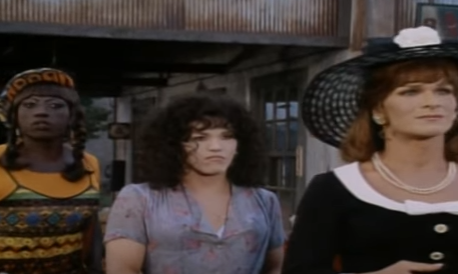
Bumps in the open road are to be expected to some extent, but the three drag queens in To Wong Foo, Thanks for Everything! Julie Newmar have a few more bumps than their fair share. Nothing goes as planned, and the cross-country adventure takes a few unexpected turns, leading to some unexpected destinations.


Screenshot from trailer
Despite the bumps, our characters prevail, as does the film, which stars three dreamy actors as Noxima, Vida, and Chi-Chi (Wesley Snipes, Patrick Swayze, and John Leguizamo).  Each of these actors are known for playing highly masculine roles (EXAMPLES). This is a fantastic move on the part of casting. This polarity between the feminized roles and the masculinized fame creates opportunity for a powerful commentary on gender expression. Men known for their masculinity are playing characters dressed in drag for a film that embraces gender diversity and fluidity.  What better way to put the concept of gender norms into question? Their masculine fame opens up opportunity for those who would not normally venture to see this film to do so, reaching an unlikely audience, and allowing the male viewers to put themselves in these women's shoes. We are endeared to these three characters not just because of their character, but because of the real person we see portraying them.

Screenshot from trailer
The film sheds light on gender violence of varies kinds--from a cop harassing the three women to a husband who beats his wife.  Not only do we witness our three protagonists receive push back on their line-crossing of gender norms as men dressed as women, but we witness how they are endangered simply by being women. The film confronts the issue unabashedly, and it is better for it.

To Wong Foo shows a small, rural town in the Midwest opening up its community to three gender-bending drag queens. They are the winners, united with the unlikely allies of the townspeople, while the cruel cop who has made it his goal to wreck havoc on their lives is shown to be an absolute idiot. By the end of the film, the whole town has come together in celebration, with every individual claiming that they are a drag queen--that they will stand by their friends, that they are on their team. The push back against homosexuality is shown to be utterly absurd.

Screenshot from trailer

One thing I do not understand is why they included the basketball and hotel scenes. I'm sure it was somebody's "baby", but it had nothing to do with the rest of the film and should have been cut.

Watch the trailer here


Chewing Gum (2015--)

Ahh, pre-sex lust. That odd fascination with an  act desperately wanted, never experienced, and always hushed up. Remember your pre-sex teenage lust? Think about it for a moment, just enough to feel embarrassed.

Screenshot from trailer
Perhaps, like myself and Chewing Gum's Tracey, your religious beliefs had you holding that lust at arm's length for awhile. A lusty fermentation.

Airing originally on the U.K.'s E4 channel, Chewing Gum takes place in London, and features Tracey (Michaela Coel), a 24-year old British woman still living at home with her deeply religious mother and sister, still dating the man she has been with for the past six years without so much as kissing him. She tries to stay devout, but sex won't stay off her mind. When it all comes down to it, she would rather be licking a man's face than praying to Our Lord Savior or spending the night playing another game of Ludo with her sister. Once Tracey unleashes her desire onto the world, life gets a little crazy.
Screenshot from trailer

Sex is sloppy and confusing at first, and nothing screams sloppy and confusing like Tracey's attempt at being sexy. The series explores her coming out of the darkness of her religion and into the blinding electric lights of life.

This is not reality as we know it. This reality is bolder, more dramatic, heightened and extended beyond the norm in the best possible way. This is a world where grandmothers take off their tops at parties and where hit-and-run victims refuse help from a sinner. The comedy is a modern slap-stick. Even when the laughs are not physical (which they often are), the outlandish situations nod to the physical.
Screenshot from trailer

Chewing Gum
 is hilarious. It is quick-paced and jam-packed, but I do not get lost. The series has a strong enough spine to keep the story straight and engaging, though it is flexible enough to take the viewer on countless twists and turns. The jokes are witty and unexpected, making me burst out laughing with empathy and recognition. Every actor plays their role with brilliant dedication. In short, don't take my word for it, go watch this series because it deserves a crowd.


Just realized that  Michaela Coel  also writes the show, which is based off of one of her plays. She is officially brilliant.

Watch the trailer here

Monday, October 31, 2016

Insecure (2016--)

I am so excited that Insecure exists. I am so excited that it exists on HBO, a major network. It is no secret that black-driven media is severely lacking in the mainstream. This show is pretty damn important in the sense that it is driven by black voices in front of the camera as well as behind the scenes, and that black women are central to its plot and creation.

Issa Rae, the brainchild behind the Awkward Black Girl YouTube series that Insecure builds and extends upon (HBO, I see you and your video-site poaching!), is funny. But that's an understaement. this woman knows how to make the uncomfortable of everyday into an art. Her humor pokes fun at everyday life, confronts the absurdity and upsetting double-standard of micro-aggressions* and racism, and is totally, lovably self-deprecating.

Screenshot from trailer
Her best friend, Molly (Yvonne Orji) is a brilliant addition. While Issa is an open hot mess, Molly seems like she has her shit together, and tries very hard to make it appear that way. She has the job, the style, and the personality--but she is not so much unlike Issa. Neither of them have their shit together. None of us really do.

Insecure has solid material, a talented cast, and the support of a major network. But it needs work.

Great jokes get lost in scenes cut too long. The pacing is paradoxically too fast, yet too slow. Plotlines are not explored deeply enough to seem significant or make sense in the show, yet they are explored too long for the viewer to not expect more (example: Issa & Molly's "Broken Pussy" rap fight, the kids going to the beach, Molly's coworker's experience with being "too black" for the office--all great plotlines that either need to be explored with more attention or not at all).

Ideas are free-floating within an episode, without the much-needed episodal or season spine holding them together. Sure, the former may be more like real life, but we are not watching to see real life. Real life is boring. We are watching to see real life represented through storytelling, and that takes some organization. As is, the series often bores me.

I hope to see the series find its form as time goes on. The potential is abundant.


Screenshot from trailer

*I spoke in another post of my frustration with college activist jargon, so it is unfair to use the term micro-aggression without an explanation. This term refers to actions and comments that subtly (though sometimes not so subtly) show and promote racism. Micro-aggressions can take many many forms, from references to stereotypes in speech, to a customer service representative watching some customers more closely than other, etc.


Watch the trailer here

Currently jamming to: Xenia Rubinos